
ECAS OPENING CEREMONY
Prague, 25 June 2025
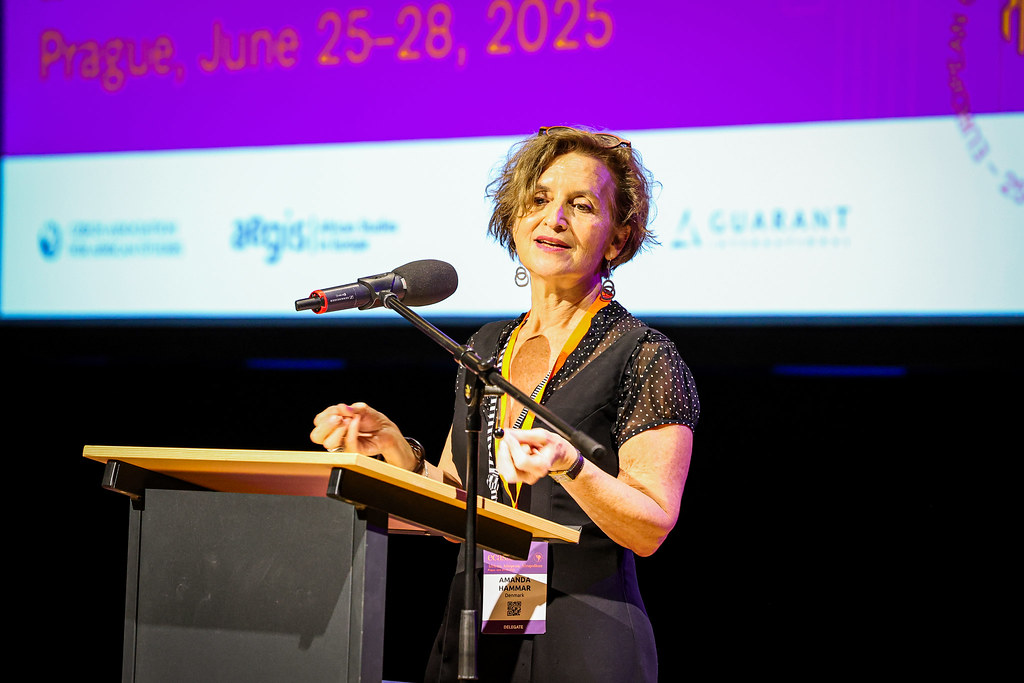
AEGIS President’s Speech
Professor Amanda Hammar
Dear honoured guests, and very dear fellow Africanists.
I am extremely honoured and delighted to be here together with you all, at the end of six years as President of AEGIS, the European African Studies Association.
In this capacity – but also personally – I would like to express both awe and immense appreciation to the organisers of this year’s ECAS conference, the Czech Association of African Studies: to Katerina Mildnerová, the current head of the Association, and to Hana Horakova as the head of the ECAS organizing committee, who together with an amazing team, supported by the conference management company Guarant, and backed up by numerous student volunteers, have provided us with an inspiring and carefully curated conference programme (https://www.ecasconference.org/2025/) . Please let’s applaud them all.
For those who somehow still might not know this, ECAS falls under the umbrella of AEGIS as one of our primary flagship events. With the exception of 2021 due to COVID, we’re proud to have held ECAS conferences in different European cities, organized with great commitment and courage by differentAEGIS members, every second year since 2005. So this then is our twentieth anniversary.
There are two other flagships or features of AEGIS that we’re equally proud of but which may not be quite as visible. One is the AEGIS-Brill African Studies book series which has a steady flow of excellent outputs and so far this year has published its 35th and 36th volumes. This series is a great avenue for publishing both monographs and edited collections. And important to note is that these automatically become open access after 18 months via the AEGIS website. (See: https://www.aegis-eu.org/aegis-brill-series)
The other major AEGIS feature we’re extremely proud of are our thematic Collaborative Research Groups (CRGs for short). These are very dynamic and inspiring research networks open to individual researchers everywhere (at no cost), through which thematic conferences and workshops are organised, new research fields opened up, important collaborations developed and publications generated. (See at: https://www.aegis-eu.org/collaborative-research-groups)
As mentioned, I am the outgoing AEGIS President – we’ll hear from the incoming president in a moment. But before I go I’d like to say very briefly what it’s meant to me to be in this role. For those who already know me, they know that I am deeply committed to the challenging and necessary work of critical African Studies, which I talk about and promote at any opportunity. As a self-described ‘African Studies activist’, I take this commitment into my own research, teaching and writing of course, but also crucially I see it in terms of community-building.
In that regard, this has been one of my genuinely heartfelt ambitions during my tenure as president, as well as being a valued opportunity in being part of AEGIS overall. This is an association of close to forty member institutions across Europe (including the UK), each with their own dynamic networks that include institutions and scholars across Africa. Working together both with a wonderful Board and the wider Plenary of member representatives, I’ve witnessed and hopefully contributed in some way to the expansion of this extraordinary community of fellow Africanists doing important work. I want to thank all my fellow Board and Plenary members for the very productive years we’ve worked together. Collectively we’re like countless pebbles creating ripple effects everywhere.
As an Association, like a state or nation, AEGIS is always under construction; always trying to confront our weaknesses and build on our strengths; always aiming to grow in responsible and meaningful ways. In relation to this, I’m truly proud that one of my almost-final acts as President has been to sign on behalf of AEGIS The Africa Charter for Transformative Research Collaborations. This commits us as an Association, and encourages our respective member institutions, to take seriously a range of epistemic, structural and relational principles outlined in The Charter that will help us critically rethink and realign the nature of research priorities and collaborations with African partners. (See: https://parc.bristol.ac.uk/africa-charter/)
My actual final act, however, is here and now to handover the AEGIS Presidency to my smart, experienced, committed and fortunately willing colleague, Professor Michael Bollig from Cologne University.