ECAS OPENING CEREMONY
Prague, 25 June 2025
AEGIS President’s Speech
Professor Michael Bollig
First and foremost: On behalf of the entire AEGIS community I would like to express my sincere and heart-felt gratitude to Amanda for six years of leadership. Amanda steered the organisation through exceptionally demanding times. AEGIS – has made it half way through this extremely difficult decade and many thanks go to Amanda, who with her energy, determinedness, and creativity kept AEGIS well on track – and even more, contributed significantly to the organizations growth, visibility and strategy development.
The challenges of the past 6 years were profound: Not long after the great Edinburgh ECAS8 conference the Corona pandemic challenged communities around the globe. Our ECAS conference in Cologne was delayed by two years. Since the early 2020s further moments of crises have added up to a spectacular fragmentation of a system that we were all kind of sure would develop to ever higher degrees of globalization and integration.
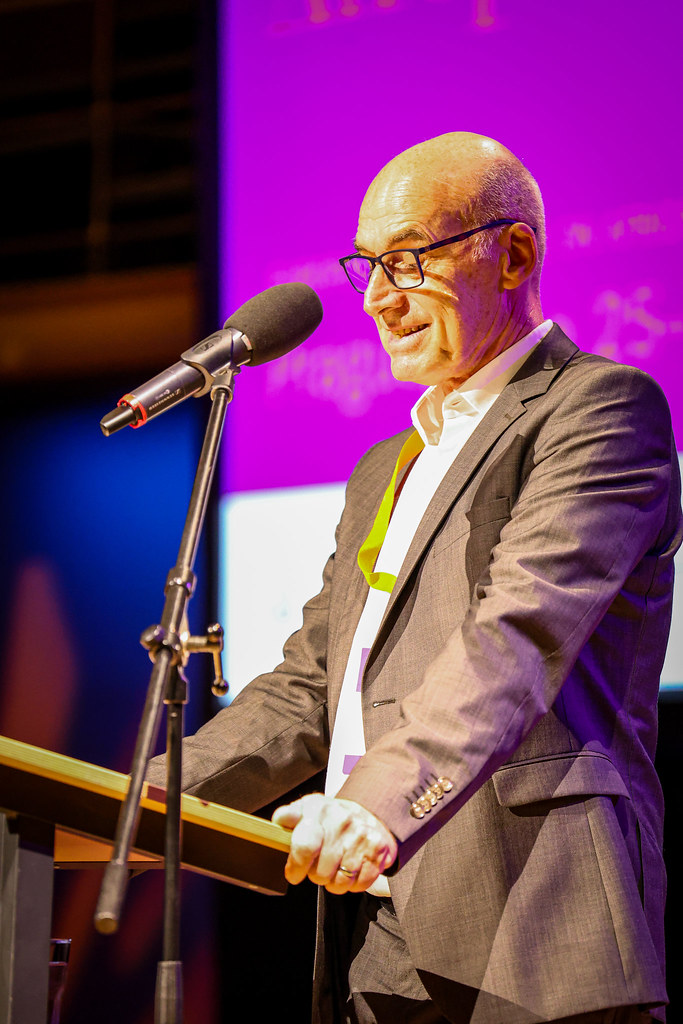
Image: Newly Appointed AEGIS President Michael Bollig at the Opening Ceremony of ECAS25 Conference, Prague, 2025
Today, planetary environmental challenges are converging with ever higher levels of inequality, exclusionary practices and eventually violence. Achille Mbembe has recently referred to this convergence as ‘brutalism’: a condition where ‘crushing forces of demolition and production on a planetary scale dominate all spheres of existence’. This planetary threat is exacerbated by authoritarian, nationalist and predatory politics.
I am honoured to follow Amanda and would like to say some very few words about me. Since 2000 I am teaching social anthropology at the University of Cologne with a regional focus on eastern and southern Africa and a keen interest in political ecology and multispecies studies. During these many years I have chaired a number of collaborative projects many of them jointly organized with African partners.
Concluding, I would like to add a few words on where I see AEGIS becoming active in the coming years, which undoubtedly will become as challenging as the first five years of the decade. The Trumpist demolition of USAid and significant reductions in development aid by many European countries are coupled with an upsurge in extractivism and the built up of ancillary infrastructure (much of it connected to the quest for a grand energy transition in the Global North), rapid demographic changes and an upsurge of violent conflicts. Mobility and immobility, wealth accumulation and increasing inequality, future-making and the emptying of futures connect our continents Africa and Europe. Aegis, a consortium of now 40 European African Studies Institutes, Platforms and Networks, its Collaborative Research Groups, its Brill Book Series and notably and foremost its biannual ECAS conferences are well posed to reflect these pertinent changes.
They will aspire to do research, to publish and to teach within a framework that has just been set by the Africa Charter, that Amanda has just signed on behalf of AEGIS. The challenge is formidable: Much of the global science system is still dominated by European and other global North countries. African scholars and institutions are, with a handful of exceptions, often lack the budgets to develop their scientific ambitions. Despite all rhetoric the academic playing field is still unjustly skewed with major consequences for Africa’s economies, people and political organisation. Eurocentric epistemologies, languages of science and theories as well as profound disparities in institutional capacities and project arrangements underpin these inequalities. The Africa Charter for Transformative Research Collaborations, co-created by Africa’s major higher education bodies now offers an orientational framework to address power imbalances in academia. AEGIS will join in the concerted effort to embed the pursuit of transformative Africa-Europe research collaborations across its member organisations and diverse affiliated research communities. I commit myself personally to further this agenda within our fabulous AEGIS network and in correspondence with partner organisations from Europe, Africa and beyond.